


Many young Africans dream of higher education. But they often don’t have the means: colleges are often far away and accommodation is expensive. Online universities and e-learning may provide a viable solution.

Lectures with compulsory attendance were not an option for Alida Tapsoba. The 29-year-old from Ouagadougou, the capital of Burkina Faso, has to earn a living and therefore needs to be in control of when she works and when she studies. With this in mind, she decided to take an online course. “But I was also afraid. I wasn’t sure if I could do it,” the journalism student told DW. “You have to be well organized to deliver the assignments on time — especially if you work extra hours.”

Alida Tapsoba said her choice is rather expensive. She spends a lot of money on internet access. She needs to download large files, which is time-consuming and costly. Rebecca Stromeyer knows the problem well. She said that in many African countries, internet access is consierably more expensive than in Germany. Stromeyer is the founder of eLearning Africa, an annual conference which attracts experts in the field to network and exchange information in a pan-African context.
No digital infrastructure
Internet access varies much across the continent. “Kenya is a pioneer, even in rural areas,” said Stromeyer. In the Central African Republic, by contrast, only a few people can accesss the internet. “Conditions are not yet so ideal that everyone in Africa can complete an e-learning program,” said Stromeyer. She adds that governments need put more efforts into developing the infrastructure.
“Nevertheless, the need to develop e-learning was much stronger in Africa than in Europe,” said the communications technology expert. And it is not restricted to university studies. The school system often does not work, especially in rural areas. There is a lack of teachers and textbooks. Stromeyer advocates using the internet for education in schools as well, although she believes that students learn better at school than they do online.
Flexible and individual
Tony Carr, from the Centre for Innovation in Learning and Teaching at the University of Cape Town in South Africa, begs to differ: “Sitting in a lecture hall with 600 other students is much like taking a degree by correspondence. Online interactions can be much warmer and personal. They can bring students closer together than a course requiring attendance.”
Flexibility is another advantage. Young people can also save on accommodation costs by staying at home and not having to rent a room in another city. They can tailor their studies to fit their needs, focus on the skills they believe to be most important and take courses they would not otherwise have access to.
 Smartphones are ubiquitous in Africa and can be put to use in e-learning
Alida Tapsoba is a case in point. She dreams of working abroad as a journalist. She could not find the master’s course she was looking for in her home town. But a renowned journalism school in Paris had just what she wanted.
South Africa’s pioneers
The University of South Africa (UNISA) pioneered distance learning on the continent. When it was founded in the 1940s it offered only degrees by correspondence. Today, it is on its way to full digitalization. By its own account, it is Africa’s largest distance learning institution.
Tony Carr refers to a research paper into online studies in Africa, which compared different countries between 2011 and 2016. It showed that South Africa was the pioneer in e-learning, followed by Angola, Nigeria and Tunisia. According to Carr, this growth goes hand in hand with internet access, income levels and the increase of the middle class in the countries mentioned.
Generally speaking, Anglophone countries lead the field, Stromeyer said. But there is a growing number of initiatives in French-speaking West Africa. Ivory Coast founded the state-run Universite Virtuelle de Cote d’Ivoire four years ago. “An outstanding institution,” said Stromeyer. “It had the advantage of being able to learn from the mistakes of others.”
High demand in African countries
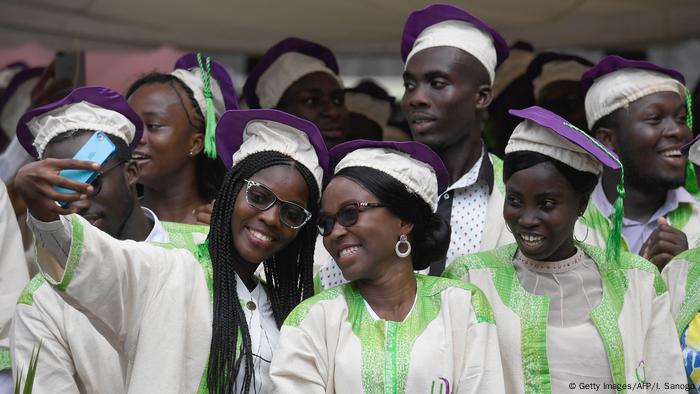 Students graduating from the first virtual university in Abidjan
Many employers still believe that online studies are worth less than degrees that require a physical presence. “They believe that the courses are shorter and that less content is conveyed,” said Stromeyer. “This is not true. The need for e-learning is great in Africa, where an above-average number of young people live. Traditional universities and student accommodation are often overcrowded.” Stromeyer recommended a mixture of online and attendance studies, since young people also have the need to socialize and be part of a community.
The main thing is to gather in-depth information about online courses and providers, Tony Carr pointed out. An online university can be located anywhere, and can circumvent the national accreditation system. Experts recommend asking precisely which degree can be obtained and whether it is recognized in your own country or abroad.
Source: DW





Add Comment